
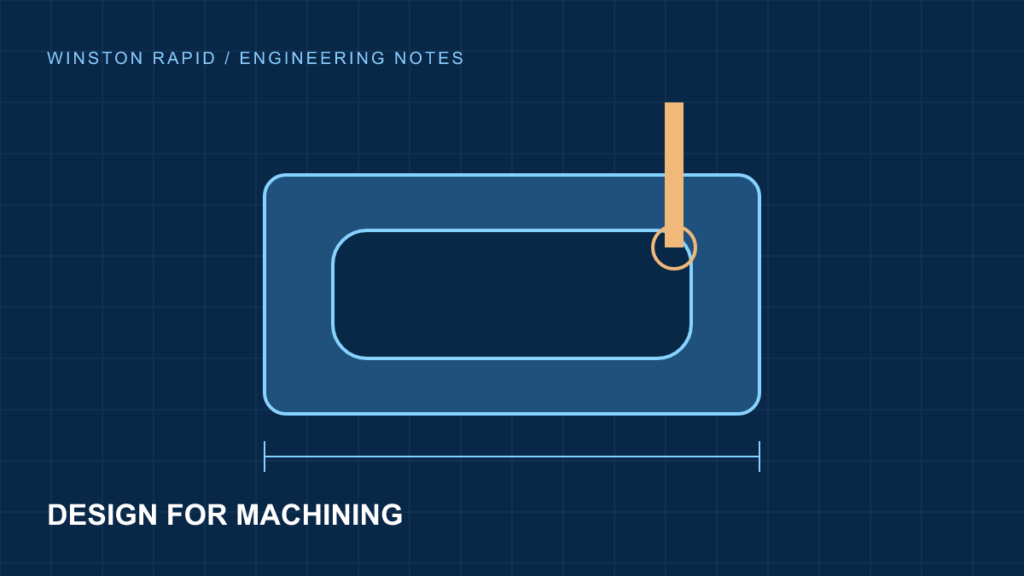
A machined feature must be reachable by a cutting tool while the part remains securely held. Reviewing tool access early can reduce unnecessary complexity without changing the part’s purpose.
Allow practical internal corners
A rotating end mill leaves a radius at an internal vertical corner. If a square mating component must fit, review a larger corner radius, a relief or a revised interface. Extremely small radii may require smaller tools and a different machining strategy.
Question deep, narrow features
A deep cavity with limited access can require slender tools and additional operations. Ask whether the full pocket depth is necessary, whether the opening can be enlarged or whether a different construction would preserve the function. The best change depends on the surrounding geometry.
Support the part during cutting
Thin walls and long unsupported features can move during machining. Consider local stiffening or a revised sequence, but do not add material without reviewing the functional requirement. Both material behavior and workholding influence feasibility.
Mark the features you cannot change
Separate flexible geometry from fixed interfaces. Explain why a particular corner, wall or cavity is required and identify the applicable drawing revision. This lets a manufacturing review focus on workable alternatives instead of assuming that every detail is equally negotiable.
Discuss your project
Share your model, drawing revision, quantity and application with Winston Rapid. Material availability, manufacturing feasibility, inspection requirements and delivery are confirmed during quotation.
Explore the related service · Request a quote · Contact us on WhatsApp
Further technical reading: Protolabs machining design considerations. External guidance describes its publisher’s processes, not Winston Rapid specifications.