
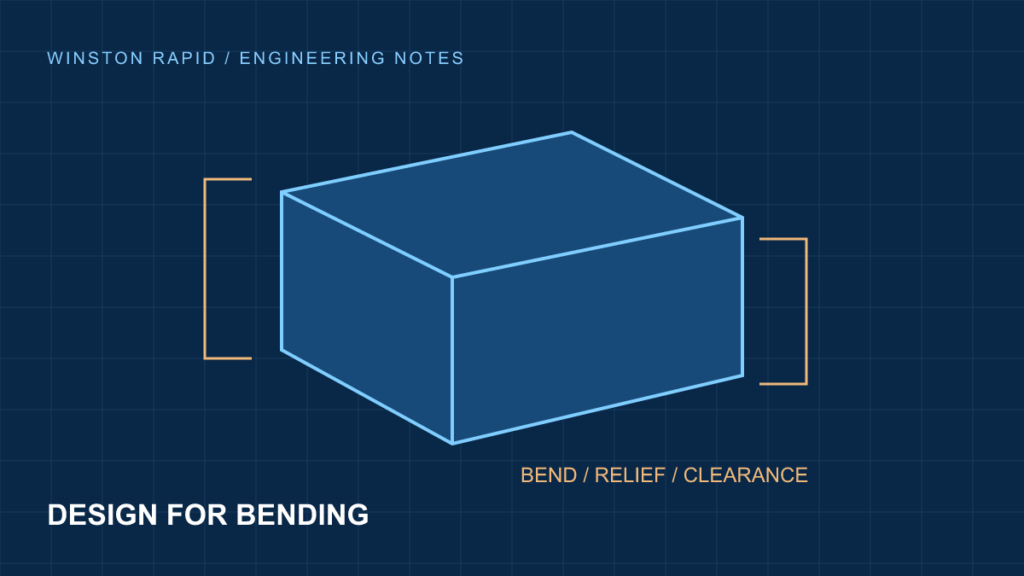
Features that look separate in a flat sheet can interact during bending. A design review should consider the final shape, the forming sequence and the space needed for tools.
Look around each bend
Review holes, slots and inserts near bend lines. Forming can distort nearby features, and a flange can limit tool access. If a location is fixed by the assembly, flag it as critical so reliefs or an alternative sequence can be considered.
Keep the material definition consistent
Specify one material grade and thickness for each sheet component. Bend radii and minimum flange dimensions depend on the material, thickness and tooling. Discuss them with the fabricator instead of applying a universal dimension to every project.
Check hardware access
Confirm that hardware can be installed after the necessary bends, and that tools can reach the installation area. Share the hardware specification rather than only a nominal hole size. Test whether a fastener can be inserted and tightened in the finished assembly.
Review the assembled condition
Dimension the interfaces that matter after forming, including gaps between panels and mounting positions. Avoid demanding tight control of every nonfunctional edge. A complete review balances assembly needs, cosmetic expectations and a feasible fabrication route.
Discuss your project
Share your model, drawing revision, quantity and application with Winston Rapid. Material availability, manufacturing feasibility, inspection requirements and delivery are confirmed during quotation.
Explore the related service · Request a quote · Contact us on WhatsApp
Further technical reading: Protolabs sheet metal design guidelines. External guidance describes its publisher’s processes, not Winston Rapid specifications.